

The Comet That May Have Destroyed a Village and Nearly Triggered an Ice Age
Evidence of a cosmic airburst at one of the world’s oldest farming villages has split scientists for almost twenty years.

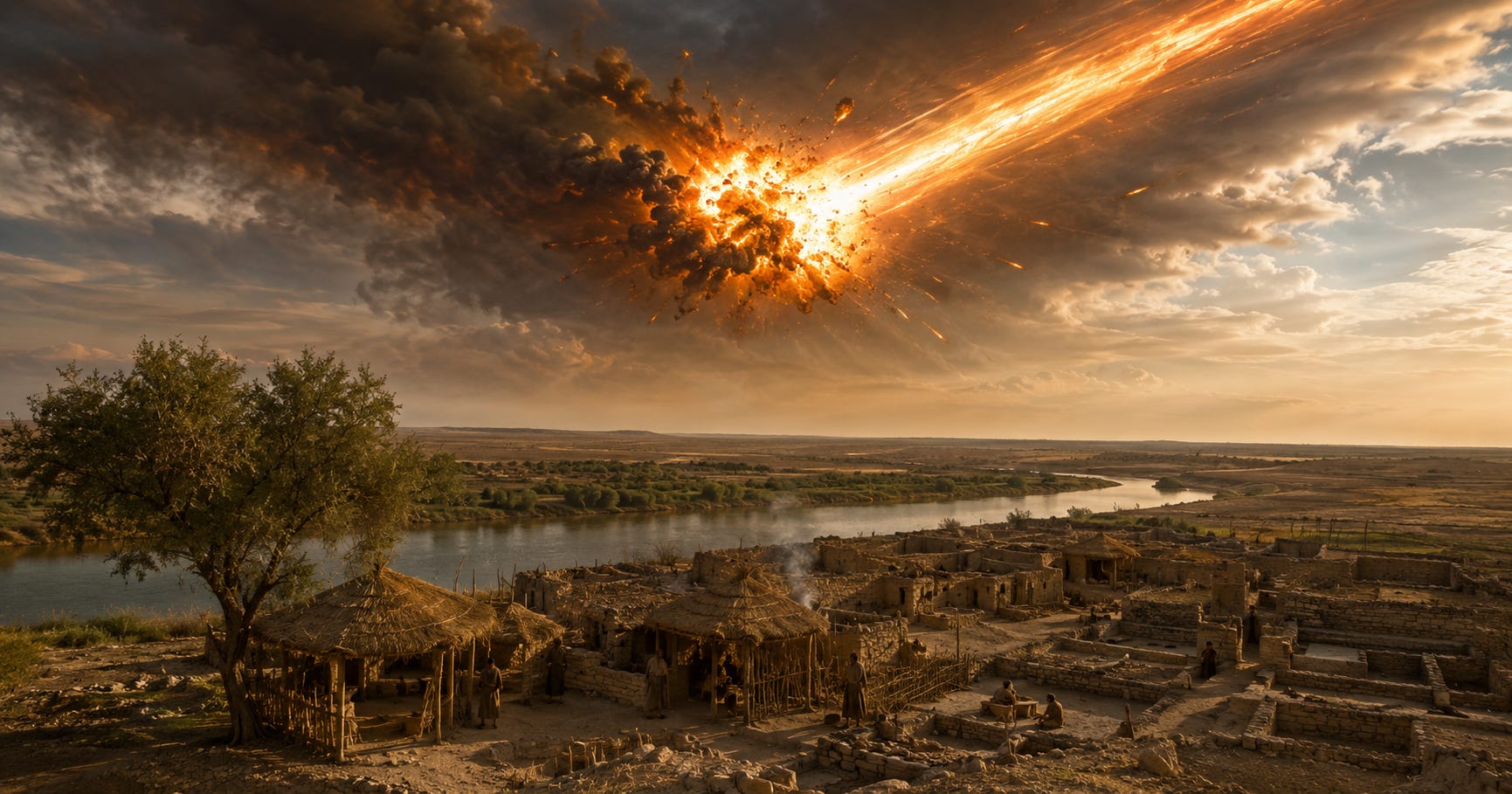
Around 12,800 years ago, at a site called Abu Hureyra beside the Euphrates River in what is now Syria, something briefly turned part of an early farming village into glass. Layers dated to this period contain droplets of melted rock, quartz grains fractured under conditions consistent with sudden extreme pressure and heat, and microscopic diamonds so small they can only be identified under an electron microscope. To the small team of researchers who first published these findings, that combination points toward a startling possibility: a fragment of a disintegrating comet exploded in the sky above the village, generating heat exceeding 2,200 degrees Celsius for a matter of seconds.
Proponents do not stop at one unlucky village. The same research group argues that a broader version of this event, a swarm of comet fragments striking or exploding above the planet at roughly the same date, triggered the Younger Dryas, a sudden and severe cooling period that plunged large parts of the Northern Hemisphere back into near-glacial conditions for well over a thousand years, upending the climate just as human populations worldwide were beginning to settle down and experiment with agriculture. Other scientists, studying the very same evidence, have reached strikingly different conclusions, and the disagreement has run for nearly two decades without a resolution either side finds convincing.
A Village at the Edge of Farming’s Beginning
Abu Hureyra matters to archaeologists independent of any comet debate. Excavations there, carried out by a team led by archaeologist Andrew Moore in the mid-1970s, uncovered close to thirteen thousand years of continuous or near-continuous occupation, spanning the exact period when local communities in the region shifted from hunting and gathering wild plants to deliberately cultivating rye and other early crops. Some researchers consider it one of the earliest sites anywhere showing that transition happening in real time, layer by layer, rather than inferred indirectly from scattered evidence elsewhere. The excavation happened only because the site sat directly in the path of the newly built Tabqa Dam on the Euphrates, and archaeologists had a narrow window of a few field seasons to dig before the entire site disappeared permanently under the rising waters of what is now Lake Assad. Whatever samples were collected before the flooding are all researchers will ever have.
Some of the plant remains recovered before the flooding, particularly rye grains that appear morphologically different from their fully wild ancestors, have been cited by certain researchers as possibly the earliest physical evidence of deliberate plant cultivation found anywhere in the world, a claim that remains debated on its own terms and adds yet another layer of scientific stakes riding on a site nobody can ever revisit.
Whatever happened during that single disputed layer, occupation at Abu Hureyra did not end there. Archaeological layers immediately above it show the settlement continuing, and eventually expanding, for thousands of years afterward, well into the period when residents were cultivating domesticated crops and keeping livestock. If a comet fragment truly devastated part of the village in a matter of seconds, whoever survived, or whoever resettled the area afterward, did not treat the location as cursed or uninhabitable. They kept living there.