


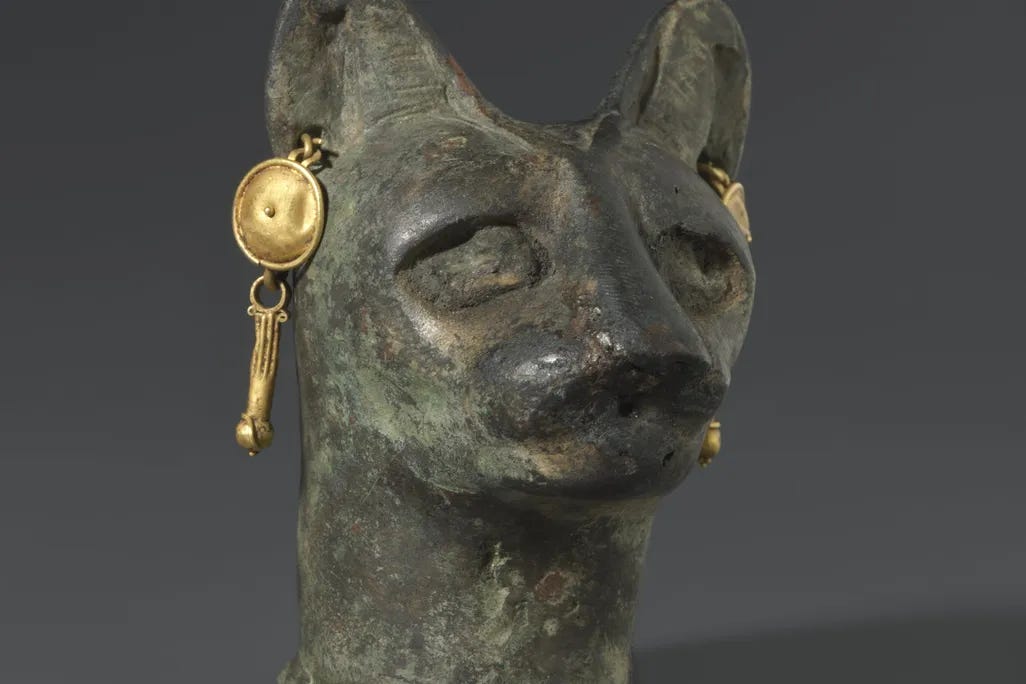
Ancient Egyptians had practical reasons to live alongside cats long before cats became closely associated with their religion. Wildcats were useful predators around settlements, where rodents were attracted to stored grain and other food supplies. Over time, cats became household animals, temple animals, religious symbols, and eventually the subject of one of the largest animal-mummification industries in the ancient world.
But the story of how cats became domesticated is more complicated than the familiar claim that early farmers in the Fertile Crescent simply invited wildcats into their homes.
For years, researchers argued that domestication began about 10,000 years ago in the Near East, when African wildcats began living around agricultural settlements. A 2017 ancient-DNA study supported that model, finding evidence that early farmers and wildcats developed a close relationship around the beginnings of agriculture.
Newer genetic evidence has complicated that picture.
A 2025 study published in Science analyzed 87 ancient and modern cat genomes and found that cats found in prehistoric Europe were not the ancestors of today’s domestic cats. Instead, domestic cats appear to have reached Europe much later, with a major expansion from North Africa around 2,000 years ago. The researchers identified North Africa as the source of the domestic-cat population that became widespread across Europe. (
The study does not prove that domestication happened in Egypt. North Africa includes several possible regions, and ancient Egyptian cat DNA remains an important missing piece of the puzzle. What it does show is that Egypt and the wider North African region played a much more important role in the history of the domestic cat than the older Fertile Crescent model suggested.
Cats Were Useful Before They Were Sacred
The original relationship between people and cats probably had little to do with religion.
Agriculture created concentrated food supplies, and concentrated food supplies attracted rodents. Wildcats already hunted those rodents. Cats that tolerated human settlements therefore had access to a dependable source of prey, while people benefited from having predators around their homes and food stores.
This kind of relationship did not require humans to deliberately breed cats for a particular job. Cats could move into settlements because the environment suited them, while the animals that were less fearful of people had an advantage over those that avoided human activity.
That helps explain why cats remained genetically and behaviorally closer to their wild ancestors than many domesticated animals. Even modern domestic cats retain many characteristics of African wildcats, and the distinction between wild and domestic populations can be difficult to establish from skeletons alone.
The ancient Egyptians did not invent the human-cat relationship, but they developed it within a society where animals had an important place in religion and everyday life.
Cats appear in Egyptian art as household animals and companions. Tomb paintings show them sitting beneath or beside chairs, sometimes near their owners during meals or other domestic scenes. They were also valued for controlling mice, rats, and snakes. The British Museum notes that cats served both as valued domestic animals and as protectors of homes and granaries.
The religious transformation came later.
Bastet Changed the Meaning of the Cat
One of the most important Egyptian goddesses associated with cats was Bastet.
Bastet’s cult center was Bubastis, in the Nile Delta. Her role changed over Egyptian history, but by the Late Period she was strongly associated with protection, domestic life, fertility, and motherhood. She could be represented as a cat or as a woman with the head of a cat.
This is an important distinction.
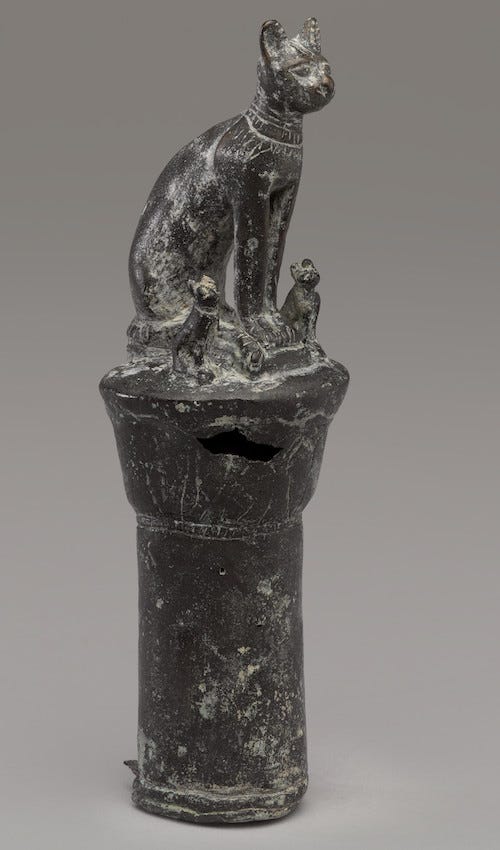
Ancient Egyptians did not simply believe that every ordinary cat was a god. Cats were associated with divine powers and could serve as physical manifestations or sacred representatives of a deity. The animal’s religious significance came from its relationship to the god, not from the idea that every household cat was itself a deity.
That distinction also explains why Egyptians could simultaneously care for cats as household animals and participate in an enormous industry involving the breeding, killing, mummification, and burial of cats for religious purposes.
The two practices were not contradictory within the Egyptian religious system.