


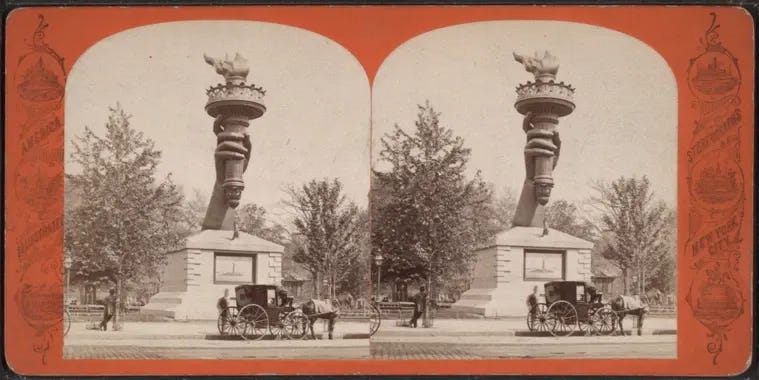
France’s gift to the United States wasn’t built all at once, and it definitely wasn’t unveiled as a single finished object. Sculptor Frederic Auguste Bartholdi built the statue’s raised arm and torch years before the rest of the body existed, displaying it at the 1876 Centennial Exhibition in Philadelphia and later at the 1878 Paris World’s Fair, both times as a fundraising tool meant to convince skeptical donors on two continents that the project was real and worth financing.
Visitors in Philadelphia could climb a ladder inside the severed arm and stand on the torch’s balcony, an experience that reportedly did more to sell the statue’s grandeur than any drawing or model could have. The rest of Liberty, the face, the robes, the tablet, wasn’t assembled around that arm until years later, once enough money had actually been raised on both sides of the Atlantic.
The Engineer History Almost Forgot
Bartholdi conceived the statue’s exterior copper shell, but he wasn’t an engineer, and copper sheeting alone couldn’t stand upright against coastal wind loads for more than a season. Original structural design fell to Eugene Viollet-le-Duc, a celebrated French architect, who died in 1879 before finishing the internal framework, leaving the project’s engineering unresolved at a critical moment.
Gustave Eiffel, a decade before his tower would make him famous, took over the internal structure and designed a flexible iron pylon and skeleton that let the copper skin expand, contract, and sway slightly in the wind without cracking, a solution closer to modern skyscraper engineering than anything else built in the 1880s. His contribution rarely gets top billing next to Bartholdi’s name, even though without it the statue would likely have torn itself apart within a few decades of standing in New York Harbor.
What the 1980s Restoration Crew Found
Liberty’s copper skin and iron skeleton were showing serious wear by the early 1980s, corroded enough that a major restoration effort began ahead of the statue’s 1986 centennial. Engineers inspecting the arm during that restoration found it attached to the shoulder at an angle noticeably different from Eiffel’s original structural plans, a discrepancy tracing back to the arm’s early, separate construction for the fundraising tour years before the rest of the frame existed.
That misalignment had quietly stressed the internal armature for a century, forcing the arm to sway more than its design intended whenever strong harbor winds hit the statue. Restoration engineers ultimately reinforced and adjusted the connection rather than attempting a full realignment, since the original mismatch had already become part of the statue’s structural history by then.
Funding lagged badly on the American side even after French donors had already paid for the statue itself, since the pedestal it needed to stand on was a separate expense nobody in Congress wanted to cover. Publisher Joseph Pulitzer used his newspaper, The World, to shame wealthy Americans into contributing, printing the names of ordinary citizens who donated even a single dollar, a campaign that ultimately raised enough small donations to finish pedestal construction in 1886.
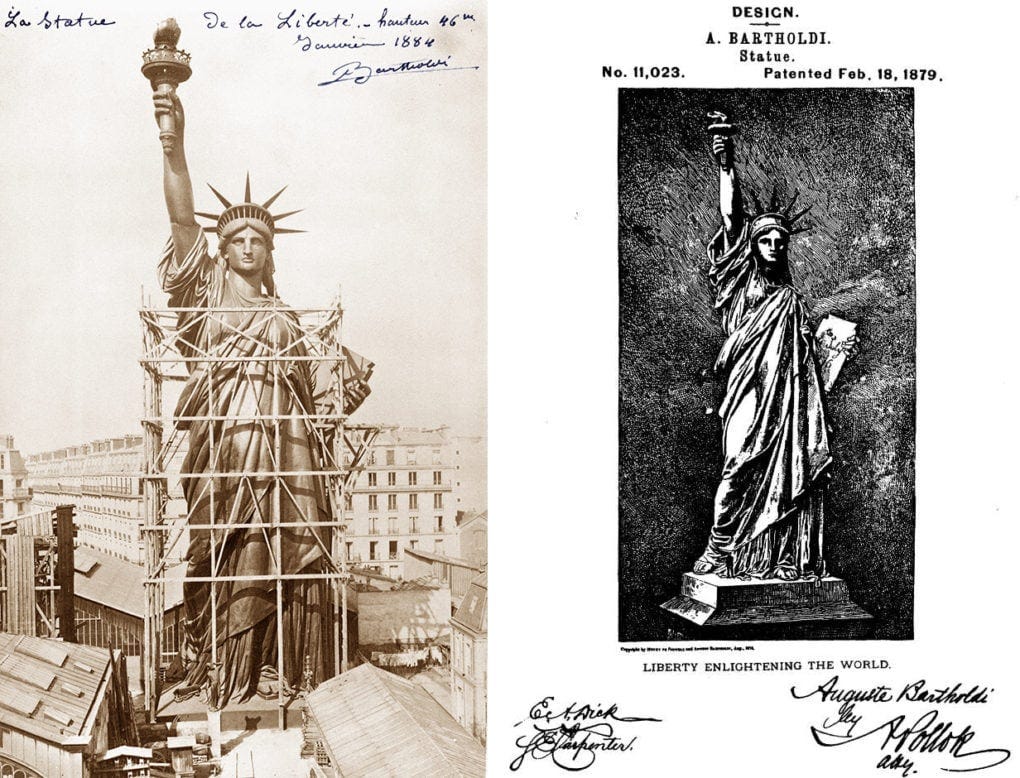
Bartholdi’s design drew consciously on the Colossus of Rhodes, one of the ancient world’s Seven Wonders, a giant bronze statue that reportedly stood near the harbor entrance at Rhodes before an earthquake toppled it around 226 BCE. Liberty was conceived from the start as a modern answer to that lost wonder, a colossus rebuilt in copper for an American harbor instead of a Greek one, and one considerably more fortunate in how long it has managed to stay standing.
A Poem Added Almost Twenty Years Later
Architect Richard Morris Hunt designed the granite pedestal Liberty stands on, and the tablet she carries reads July 4, 1776 in Roman numerals rather than any date connected to the statue’s own dedication in 1886, a deliberate choice tying the monument back to American independence rather than to France’s gift itself.

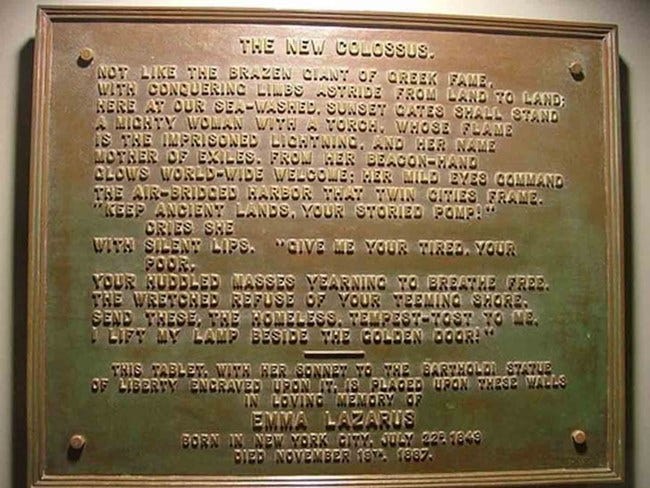
Emma Lazarus wrote her sonnet The New Colossus, the poem containing the famous line about tired, poor, huddled masses yearning to breathe free, in 1883 to help raise money for the pedestal, years before the statue was fully assembled. The poem was largely forgotten after that fundraising campaign ended and wasn’t permanently mounted inside the pedestal until 1903, seventeen years after Liberty’s dedication, meaning the words most people now associate instinctively with the statue’s meaning were, for its first two decades, nowhere near it at all.
Even the color is a later addition nobody planned for. Liberty’s copper skin arrived in New York a warm, reddish brown, closer to a new penny than the pale green familiar today, and only oxidized into its current patina gradually over roughly the statue’s first three decades outdoors, a chemical transformation nobody involved in the original design specifically intended as part of the visual effect.
If the poem, the pedestal, and the arm were all added or adjusted years apart from each other, how many other monuments are we treating as a single moment when they were really built in pieces?

“Happy birthday, Lady Liberty!” 🇫🇷🇺🇸
I love reading about historical things like this. Thank you!