


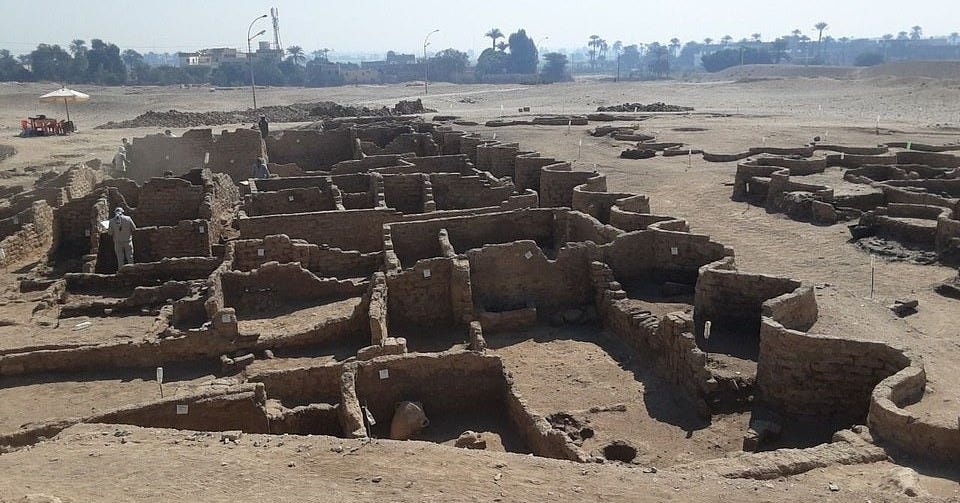
In September 2020, Zahi Hawass’s team started digging near Luxor with a modest goal: locate Tutankhamun’s mortuary temple, a specific, fairly narrow target. Weeks in, mudbrick walls far too extensive for any single temple started emerging from the sand. By April 2021, Hawass was announcing something much bigger, a nearly complete ancient city dating to the reign of Amenhotep III, preserved to a height of several meters in places.
That level of preservation is unusual on its own. Most ancient Egyptian cities got built over and rebuilt on the same ground for centuries, erasing whatever came before. This one wasn’t. Excavators nicknamed it the Rise of Aten, after an inscription referencing the sun disk that would later become central to a very different, much stranger chapter of Egyptian religious history.
A Bakery, Not a Tomb, Is What Actually Tells the Story
Amenhotep III ruled during what historians generally consider the wealthiest, most stable stretch of the New Kingdom, before his son Akhenaten’s religious revolution upended everything. Diplomatic letters from the period, preserved at Amarna, show Egypt negotiating as the dominant regional power. The city that supported that wealth wasn’t ceremonial. It was industrial: distinct neighborhoods for bread production, meat processing, and large-scale mudbrick manufacturing at the exact scale Amenhotep III’s building projects would have required.
Wine jars found on site carry labels recording the vineyard of origin, the vintage year, and the name of the chief winemaker. Ration records track distribution across the settlement with a bureaucratic rigor that would look entirely familiar to a modern inventory manager. None of it is glamorous. Almost none of it will ever hang under museum lighting the way a gold mask does. It’s also, arguably, more useful, since it shows how a functioning ancient economy actually ran day to day rather than how a pharaoh wanted to be remembered.