


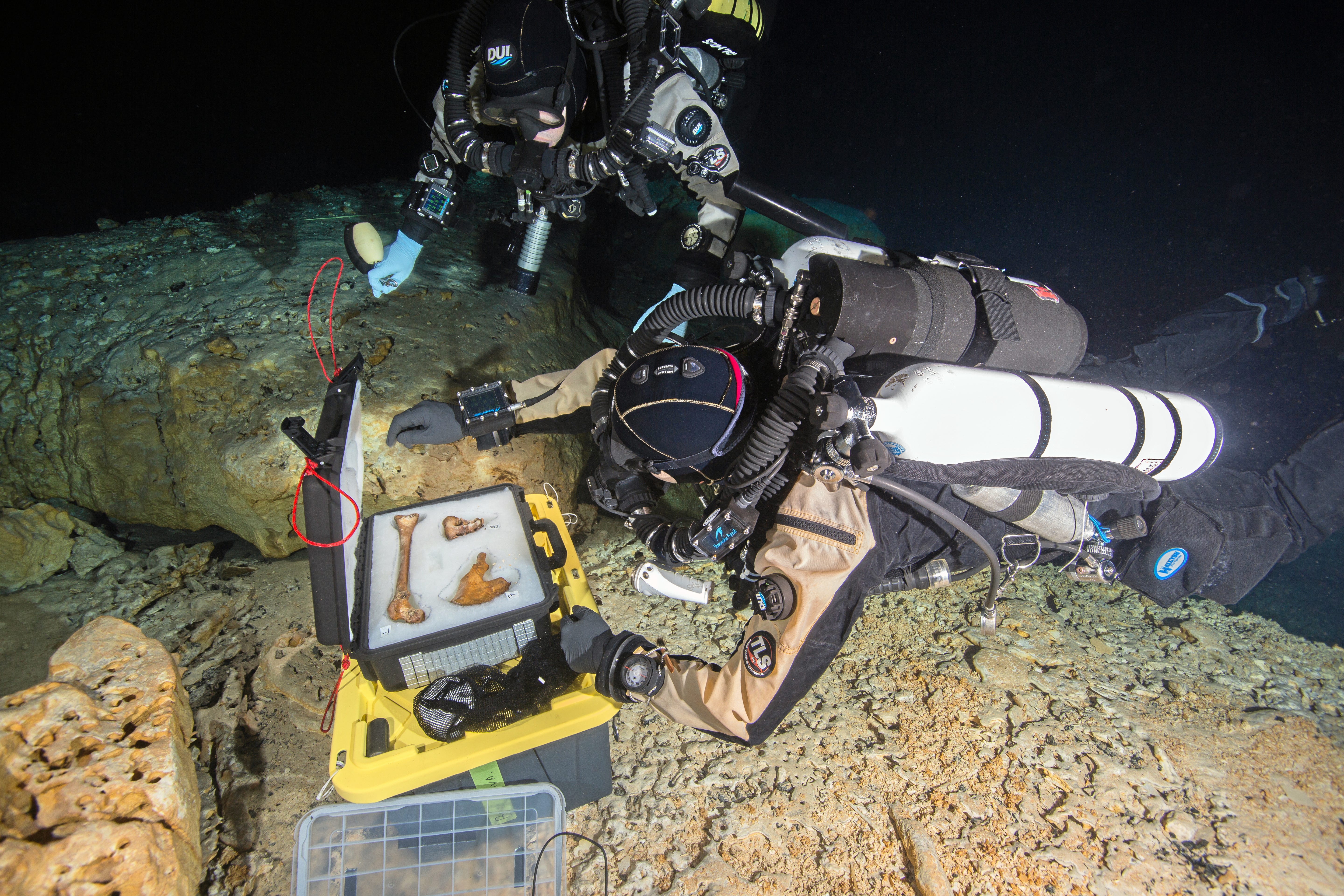
Alberto Nava wasn’t hunting for human remains. He was a recreational cave diver exploring an unmapped stretch of Mexico’s Sac Actun system in 2007, following a passage out of simple curiosity about where it went. Where it went was Hoyo Negro, a bell-shaped pit more than a hundred feet down, and his light landed on a floor scattered with bones that were unmistakably not recent.
Saber-toothed cat. Giant ground sloth. An extinct short-faced bear. And, laid out among them, a nearly complete human skeleton, later named Naia after the Greek water nymphs, that had been resting there for somewhere between 12,000 and 13,000 years.
Why It Took Four More Years to Touch Her
Finding Naia and recovering her were two entirely different problems. Hoyo Negro’s depth and its narrow, silt-choked entrance meant early dives could only document what was visible, never disturb it. Formal recovery, involving Mexico’s National Institute of Anthropology and History and a small team of technical divers trained specifically for a pit this demanding, didn’t begin in earnest until 2011. It continued in careful stages for several more years after that.
National Geographic helped fund the effort. Before a single bone moved, the team built a full 3D photogrammetric model of the chamber, so the exact spatial relationship between Naia and the animals around her would survive even after the physical remains were lifted out. During the last Ice Age, sea levels sat far lower and this chamber was dry, a natural pitfall trap rather than a flooded tomb. Whatever fell in, animal or teenage girl, couldn’t climb back out. Rising water sealed it afterward, and kept it sealed for ten thousand years.