

The Phaistos Disk: The Undeciphered Message Nobody Can Agree On

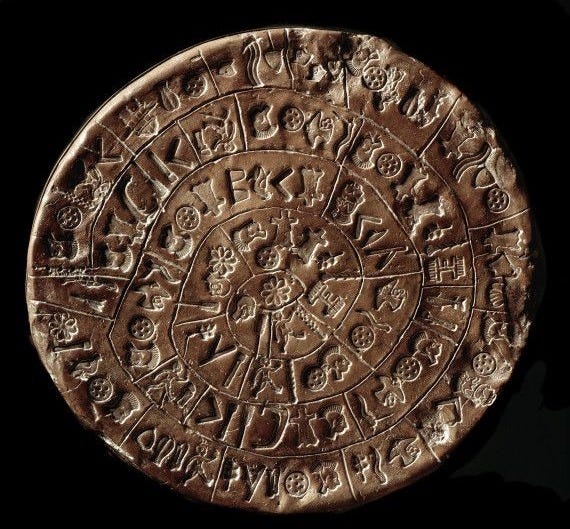
In 1908, an Italian archaeologist named Luigi Pernier was excavating the Bronze Age palace of Phaistos on the island of Crete when he found something that has baffled researchers ever since. Buried in the ruins of a small room, sealed under undisturbed debris, was a clay disk about 16 centimeters across. Both sides were covered in symbols 241 of them in total, arranged in a spiral, pressed into the clay with individual stamps before it was fired.
The Phaistos Disk is unique. No object like it has ever been found anywhere else in the world. The symbols do not match any known script. After more than a century of analysis by linguists, archaeologists, and cryptographers, nobody has convincingly deciphered it and the debate over what it even is has become one of archaeology’s most entertaining ongoing arguments.
What We Actually Know
The disk dates to around 1700 BCE, placing it in the Middle Minoan period, when the Minoan civilization was at its height on Crete. It was found in what excavators believe was a temple repository a storage area beneath the palace floor. The clay is local to the region, and it was fired, which preserved it far better than the unfired clay tablets that make up most Bronze Age writing.
The 241 symbols represent 45 distinct signs. They depict recognizable things a human figure, a head with a feathered headdress, a fish, a bird, a hand, a beehive, a running man. Each sign was pressed into the clay using a pre-made stamp, which is itself unusual: stamped text implies someone had a set of pre-prepared symbols ready to use, suggesting either a writing system in regular use or a very deliberate, one-off production.
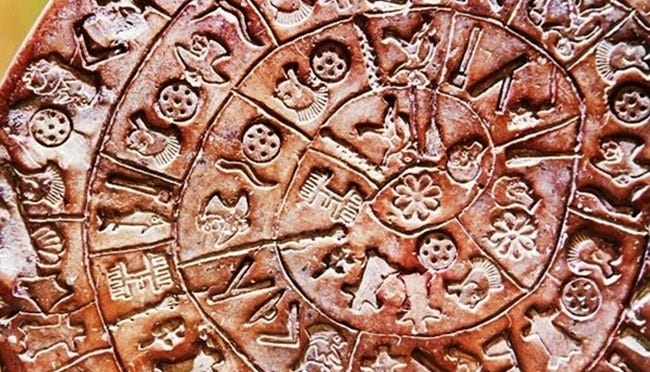
The symbols are grouped into 61 “words” clusters separated by incised lines and both sides of the disk read from the outside edge toward the center, or possibly the other way around. Nobody agrees on that either.
What we do not know is almost everything else. We do not know the language. We do not know whether it encodes a syllabic system, an alphabet, a logographic system, or something else entirely. We do not know what it says. We do not even know with certainty which direction it should be read.
The Decipherment Claims (and Why They Keep Failing)
Dozens of researchers have claimed to crack the Phaistos Disk. Almost none of those claims have survived scrutiny.
The core problem is statistical. With only 241 symbols representing 45 distinct signs, the dataset is simply too small to verify any proposed decipherment. A competent cryptographer can make almost any short text seem to decode into something meaningful if you are flexible enough about the underlying assumptions. Several proposed readings have translated the disk into Minoan prayers, hymns to a goddess, astronomical calendars, and a military roster a range of outcomes that tells you more about the flexibility of the decipherment methods than about the disk itself.
Serious linguists point out that any credible decipherment of the Phaistos Disk would need to be independently testable. Linear B, the Bronze Age script deciphered by Michael Ventris in 1952, was cracked precisely because there were thousands of tablets to cross reference. Ventris could test his proposed readings against multiple documents and verify them. The Phaistos Disk offers one document, in an unknown language, with no parallel text. It is, in cryptographic terms, nearly impossible to solve under those conditions.
That has not stopped people from trying. In 2014, Gareth Owens of the Technological Educational Institute of Crete announced he had identified the language as an early form of Greek and translated portions of Side A as references to a pregnant mother goddess. The claim received considerable press coverage. It also received considerable skepticism from other Aegean linguists, who noted that the proposed readings relied on assumptions about the underlying language that cannot be independently verified from the disk alone.
Is It Even Genuine?
The authentication question has lingered since the 1970s, when a small number of scholars began raising doubts about the circumstances of the disk’s discovery. It was found by Pernier alone, without witnesses, and his field notes from that day are unusually sparse. No other object like it has ever turned up in any excavation anywhere.
In 1999, Jerome Eisenberg, a specialist in ancient art forgeries, published a paper arguing the disk was a modern fake possibly created by Pernier himself to boost his career. His argument rested partly on the uniqueness of the object and partly on the pristine condition of the fired clay, which he felt was inconsistent with genuine Bronze Age artifacts from the same context.
The archaeological establishment has not accepted this argument. Thermoluminescence testing of the disk’s clay, conducted in the 1980s, dated it to roughly the period indicated by the excavation context. The palace stratigraphy around where it was found has been thoroughly examined and shows no signs of disturbance consistent with planting. Most Aegean archaeologists consider the forgery hypothesis adequately addressed, if not definitively closed.
But “adequately addressed” is different from “settled.” The disk remains without parallel. Every other Minoan and Bronze Age script Linear A, Linear B, Cretan Hieroglyphic appears on multiple objects from multiple sites. The Phaistos Disk appears once, nowhere else, and does not match any of them.
More than a century after its discovery, the Phaistos Disk sits in a case at the Heraklion Archaeological Museum, drawing more visitors than almost anything else in the collection. It has been reproduced on jewelry, refrigerator magnets, and countless book covers. And it remains exactly as mysterious as the day Pernier pulled it out of the ground.
So here is what I keep coming back to: we have found one of these, in one place, once. Does that mean it was unique even in its own time a single object made for a single purpose that we cannot now recover? Or does it mean dozens of others existed and simply have not survived, or have not been found yet? One more disk, from one more site, could change everything. It could also confirm that we have been spending a century asking the wrong questions entirely.

References
Chadwick, J. (1990). The Decipherment of Linear B. Cambridge University Press
Eisenberg, J. M. (2008). The Phaistos Disk: One hundred years of attempts to decipher the world’s most famous clay tablet. Minerva, 19(5), 11-22.
Godart, L. (1995). The Phaistos Disc: The Enigma of an Aegean Script. Itanos Publications.
Owens, G. (2014). Identifying a Minoan goddess on the Phaistos Disk. European Journal of Humanities and Social Sciences, 28(1).
Pernier, L. (1908). Un singolare oggetto fittile della prima eta minoica. Ausonia, 3, 255-258.
ghosts sharing ritz crackers ; lots of daisies. 😺
I have a replica of it on my desk I picked up in Greece.