

Ancient Rome’s Concrete Secret: Why We Still Can’t Replicate It

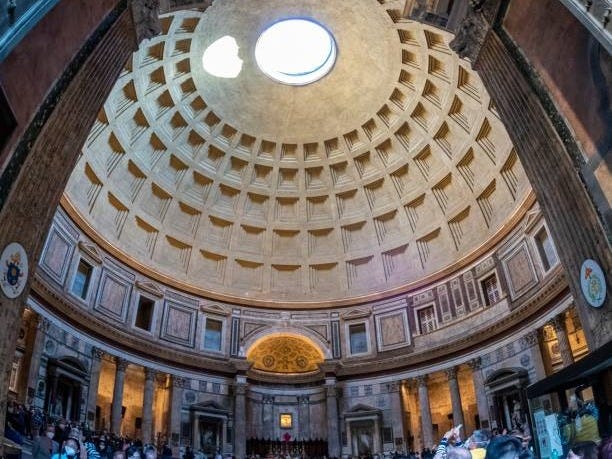
The Pantheon’s dome has been standing for almost 1,900 years. Unreinforced. No steel rebar, no maintenance injections, no structural intervention beyond some medieval repairs to decorative elements. It is the largest unreinforced concrete dome in the world, and it is doing fine.
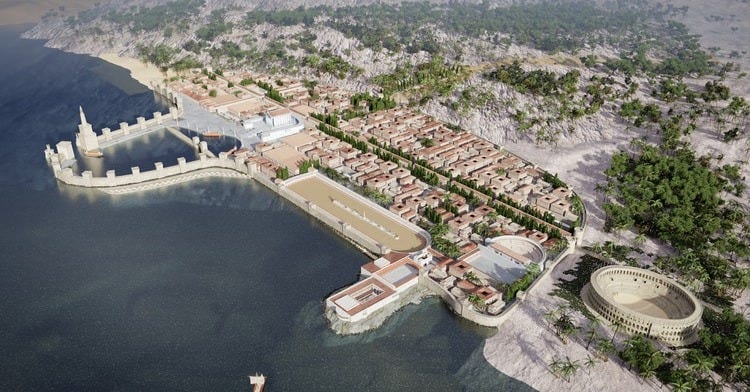
Modern concrete starts cracking within decades. Infrastructure engineers budget for a 50 to 100 year service life on major concrete structures, with significant maintenance requirements throughout. The concrete in the Roman harbor at Caesarea Maritima, built around 20 BCE, is not only intact but has been actively strengthening for two millennia, as seawater gradually reinforces it at the molecular level.
This is not mythology. Roman concrete outperforms modern Portland cement concrete in specific conditions, particularly in marine environments and over geological timescales. The question of why and whether we can replicate it has moved from archaeology into materials science, with some recently published results that are as interesting as anything in the original engineering.
What Roman Concrete Actually Was
Roman concrete opus caementicium was not what most people picture when they hear the word concrete. It was not poured from a mixer. It was built up in layers, with workers packing a mortar mixture of volcanic ash (pozzolana), lime, and seawater around rubble, stone, and ceramic fragments. The volcanic ash was the key ingredient. Romans quarried it from deposits around the Bay of Naples, particularly from Pozzuoli (hence pozzolana), and it gave their mortar a chemical composition fundamentally different from modern Portland cement.
Portland cement hardens through a process called hydration a chemical reaction between cement compounds and water that produces calcium silicate hydrate, the binding mineral that gives concrete its strength. The reaction is largely complete within a few months. After that, the concrete does not change much chemically. It slowly weakens over time through carbonation, chloride penetration, and freeze thaw cycles.
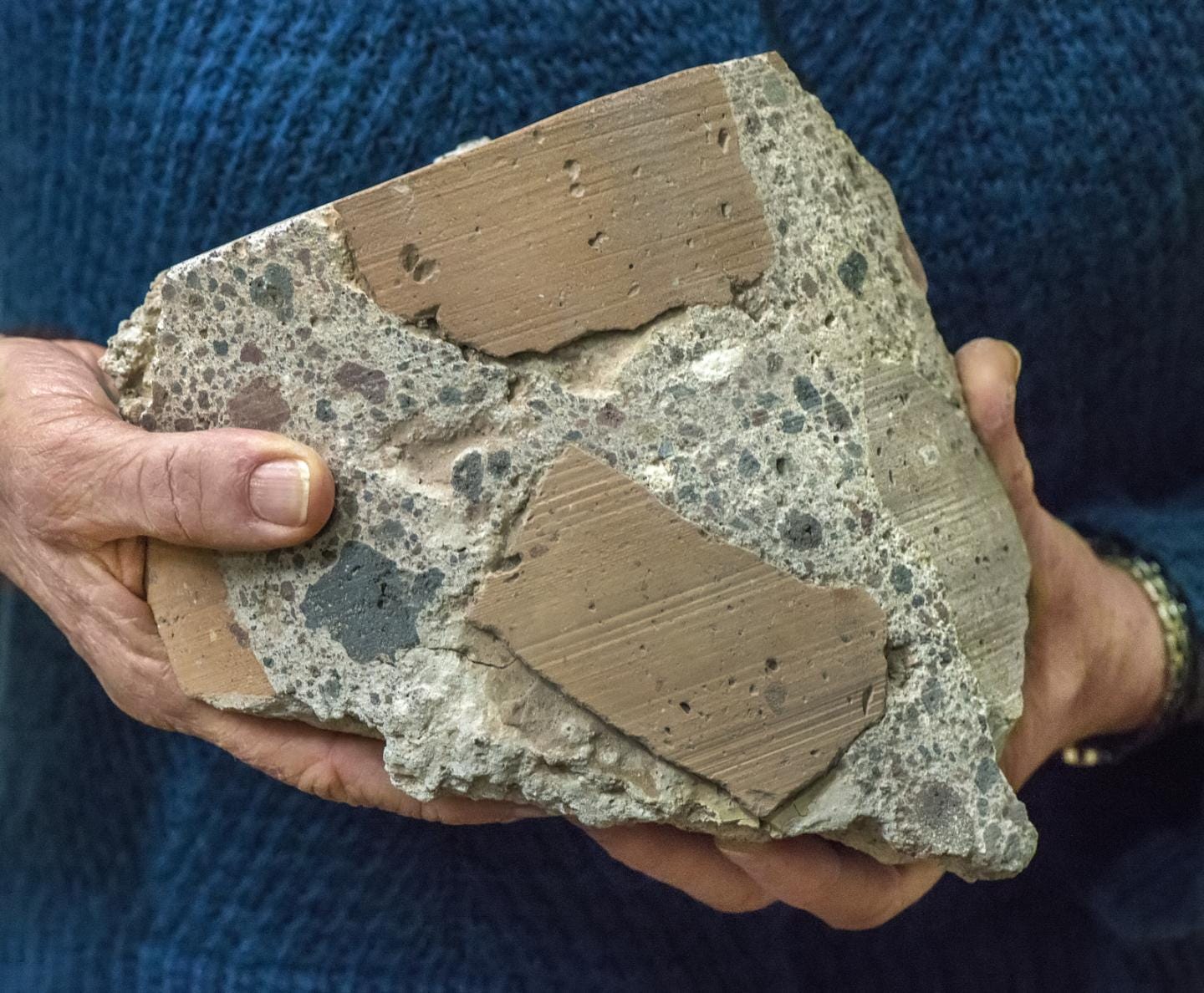
Roman pozzolanic concrete does something different. When volcanic ash reacts with lime and seawater, it produces not only calcium silicate hydrate but also tobermorite a rare mineral that actually grows within the concrete matrix over time. A 2017 study led by Marie Jackson of UC Berkeley and published in American Mineralogist analyzed cores from Roman harbor structures and found that the tobermorite crystals were continuing to grow after 2,000 years, reinforcing the concrete from the inside. This is a material that heals itself.
The seawater is not incidental. It is part of the reaction. Roman harbor concrete was designed to be built in the ocean, using ocean water, and the chemical interaction between seawater minerals and the volcanic ash mortar is precisely what produces the long-term strengthening effect. Modern concrete cannot be built in contact with seawater without rapidly degrading due to chloride attack on the steel reinforcement. Roman concrete had no steel reinforcement to attack, and the seawater was an ingredient rather than a threat.
Why We Have Not Simply Copied It
The obvious question is: if Roman concrete is demonstrably better for certain applications, why are we not using it?
Part of the answer is industrial scale. Portland cement can be manufactured anywhere, standardized precisely, and produced in enormous quantities. Pozzolana from the Bay of Naples cannot. There are pozzolanic materials in other locations some volcanic regions produce usable ash, and certain industrial byproducts like fly ash have similar chemical properties but they are not interchangeable, and the Roman formula was optimized for a specific local material.
Part of the answer is also time. Roman concrete structures take longer to reach full strength than Portland cement structures, and they cure differently. Modern construction schedules do not accommodate a building material that improves over decades. The infrastructure and investment that goes into planning a structure assumes predictable, rapid curing materials that meet standardized strength specifications at 28 days. Roman concrete does not work on that schedule.
The more interesting problem is compositional variation. Roman concrete was not a single standardized formula. Ancient builders in different regions used different volcanic ash sources, different lime preparations, and different proportions adapted to local materials and specific applications. Vitruvius, the Roman architect and engineer who wrote the most extensive surviving ancient technical manual, describes several concrete types for different uses. Modern engineers need a specification they can reproduce reliably. The Roman approach was closer to skilled craft judgment than to industrial standardization.
What the Latest Research Shows
A 2023 study published in Science Advances by a team including Jackson and colleagues at MIT and Harvard examined Roman concrete from sites across Italy and the Mediterranean. They identified a previously overlooked feature in the microstructure: small, bright white calcium-rich fragments distributed throughout the matrix. Earlier researchers had assumed these were poorly mixed lime clasts evidence of sloppy construction. The 2023 analysis found they were something else entirely.
The fragments have a highly porous, reactive nanostructure. When cracks form in the concrete and water infiltrates, these calcium rich inclusions dissolve slightly and reprecipitate as new mineral crystals that fill the crack. It is, in engineering terms, a self-healing mechanism and it appears to have been intentional. The Roman concrete was mixed at very high temperatures (a process called “hot mixing”), which produced a lime-rich matrix that retains its reactivity for centuries. This is not an accidental feature of the chemistry. Someone understood empirically if not chemically that a certain mixing process produced concrete that lasted.
The Romans did not have a materials science department. They figured this out by watching what worked over generations and refining the practice accordingly. We have had 2,000 years to study their results, and we are only now understanding the mechanism.
Which raises the obvious question: are we actually going to use any of this? The answer, increasingly, is probably yes at least for specific applications. Research teams at several universities are developing modern pozzolanic cement formulas optimized for marine infrastructure, seawall construction, and other environments where long-term durability matters more than rapid curing. The Roman harbor at Caesarea Maritima has become a design reference for 21st century coastal engineers.
So here is what I keep wondering about: the Romans built concrete that improves with time in an ocean environment, using a volcanic ash that happened to be available near one of their major cities. Did they know what they had? Or did they build the Pantheon not because they understood the chemistry, but because centuries of trial and error had given them a formula that worked and we are only now catching up to what they already knew?
When Fashion Started Revolutions

On June 7, 1943, sailors prowled Los Angeles streets hunting for young men in oversized wool suits. They dragged teenagers from theaters and diners, stripped them, and burned their clothing in bonfires. The crime? Wearing zoot suits during wartime, high-waisted pants with baggy legs that servicemen viewed as unpatriotic waste of rationed fabric. But the violence exposed a deeper truth: when authorities fixate on hemlines and hat styles, fabric becomes battlefield.
References
Brandon, C. J., et al. (2014). Building for Eternity: The History and Technology of Roman Concrete Engineering in the Sea. Oxbow Books.
Jackson, M. D., et al. (2017). Phillipsite and Al-tobermorite mineral cements produced through low-temperature water-rock reactions in Roman marine concrete. American Mineralogist, 102(7), 1435-1450.
Jackson, M. D., et al. (2023). Hot mixing: Mechanistic basis for the durability of ancient Roman concrete. Science Advances, 9(1).
Lancaster, L. C. (2005). Concrete Vaulted Construction in Imperial Rome. Cambridge University Press.
Oleson, J. P., et al. (2004). Geological and chemical study of Roman pozzolanic concrete. Journal of Roman Archaeology Supplement, 57.
Fascinating!
First time reader, will not be a one-and- done, for certain. Very well written, clear, explanatory w/o being dumbed down or condescending. Nice work.