



On one side of the grave: Roman military equipment. Belt fittings, personal items consistent with service in the Roman army, objects that placed him clearly within the imperial military system. On the other side: a Germanic longsword, a weapon of the type carried by the people Rome spent generations fighting, trading with, and absorbing along its northern borders. The sword was not a trophy. It was not displayed at an angle to suggest capture. It was placed carefully alongside him, as if it belonged there.
Burials like this one, found at sites along the Roman frontier in the Danube region, have been accumulating quietly in the archaeological record for decades. They are not common. But they are not isolated either. And what they suggest about identity, loyalty, and the reality of life on the empire’s edge is considerably more complex than the clean Roman-versus-barbarian boundary that the history books have traditionally drawn.
Who Served on the Frontier
The Roman military of the first through third centuries CE was not a force composed exclusively of Roman citizens from Italy. By the second century, the army had become one of the most genuinely multicultural institutions in the ancient world. Auxiliary units, which made up a substantial portion of Rome’s frontier forces, were recruited from the provinces and from peoples along the empire’s borders. Dacians, Germans, Gauls, Syrians, North Africans: all served in Roman formations, often in units named for their ethnic origin and sometimes stationed far from their homelands.
On the Danube frontier specifically, the population dynamics were complex. Germanic-speaking groups lived on both sides of the river. Men from those communities served in Roman auxiliary units. Their relatives, sometimes literally, fought against Rome during the Marcomannic Wars of the 160s and 170s CE. Roman emperors settled Germanic groups inside the empire’s borders as agricultural workers and military recruits. The frontier was not a line. It was a zone of continuous movement, negotiation, and exchange.
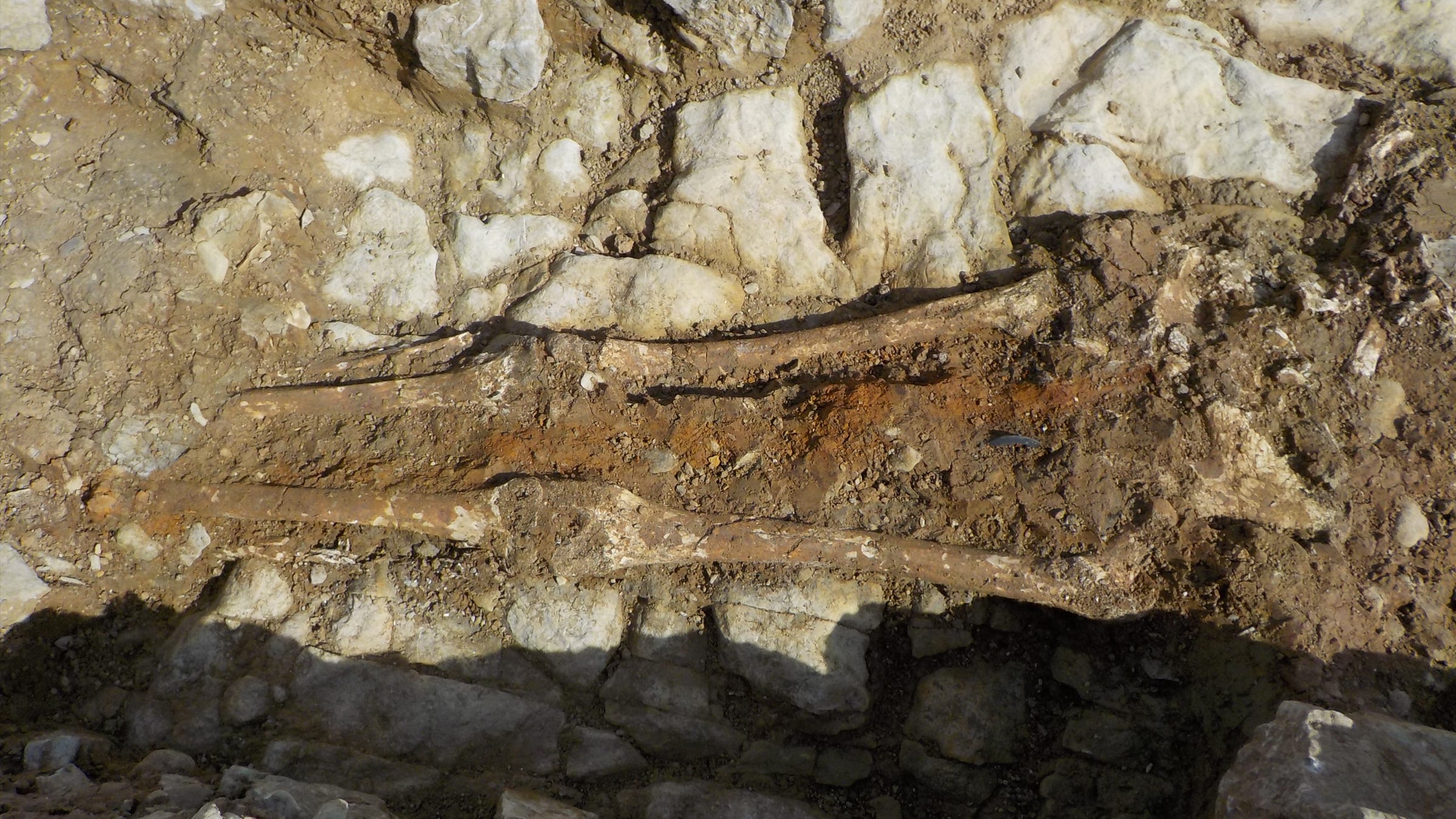
Against that background, a man buried with both Roman military equipment and a Germanic sword is not an anomaly that requires an elaborate explanation. He is a product of his environment. The more interesting question is what the burial itself was intended to communicate, and to whom.
What the Burial Choices Mean
Burial archaeology is always interpretively delicate. Objects placed in a grave reflect decisions made by the living, not necessarily the self-perception of the dead. The people who buried this man chose to include both sets of objects. That choice could reflect several things: a community that understood him as having a dual identity, a family that wanted to honor multiple aspects of his life, or simply a pragmatic acknowledgment that both sets of objects belonged to him and should accompany him.
What it does not suggest is that he was hiding one identity from the other. The Roman equipment and the Germanic sword were placed together, openly. Whatever tension existed between those two worlds in political or military terms, it was not a tension this burial was trying to resolve or conceal. The man who was buried there had apparently lived with both, and the people who buried him saw no contradiction in honoring both.
Similar patterns appear elsewhere along the frontier. Germanic-style brooches found with Roman military belt sets. Roman coins placed alongside objects of clearly non-Roman manufacture. Inscriptions that combine Latin names with Germanic ones, or that use Latin to commemorate individuals whose naming practices suggest indigenous origins. The material culture of the frontier is full of these combinations, and scholars working on Roman-Germanic interaction have increasingly moved away from the assimilation model, which assumed that contact with Rome progressively erased indigenous identities, toward a more fluid picture in which people moved between cultural registers depending on context.

Identity on the Edge of Empire
The Roman military offered a specific kind of identity transformation. A man who served his full term of auxiliary service, typically 25 years, received Roman citizenship upon discharge. His children were born Roman citizens. The legal and social transition was real. But legal status and lived identity are not the same thing, and the archaeological record consistently shows that the transition was not complete in the ways that formal citizenship might suggest.
Veterans settled near the forts where they had served, in communities that maintained connections to both Roman and indigenous cultural practices. Their funerary choices reflect that double inheritance. They were Roman enough to use Roman grave forms, to include Roman objects, to commemorate themselves in Latin. They were also something else, something that the Roman category did not fully contain, and the objects that did not fit the Roman template were included anyway.
The soldier buried with a Germanic sword was, in some sense, doing what people on borders have always done. He was holding two worlds at once. The fact that his community buried him that way suggests they understood it as a legitimate way to be, not a contradiction to be resolved but a reality to be acknowledged.
Roman frontier archaeology has spent decades working through what the empire actually looked like from its edges. The answer that keeps emerging is that the edges were far more porous, far more negotiated, and far more interesting than the center imagined. The man in that grave on the Danube knew things about Rome and about the people beyond its borders that most Romans never would. His burial, with its careful arrangement of objects from both worlds, is a more honest record of what the frontier actually was than most of the texts that survive from it.
What does it mean for an empire to draw a line, when the people defending that line refuse to stay on one side of it?
References
Haynes, Ian. Blood of the Provinces: The Roman Auxilia and the Making of Provincial Society from Augustus to the Severans. Oxford University Press, 2013.
Wells, Peter S. The Barbarians Speak: How the Conquered Peoples Shaped Roman Europe. Princeton University Press, 1999.
Elton, Hugh. Frontiers of the Roman Empire. Indiana University Press, 1996.
Whittaker, C.R. Frontiers of the Roman Empire: A Social and Economic Study. Johns Hopkins University Press, 1994.
Woolf, Greg. Becoming Roman: The Origins of Provincial Civilization in Gaul. Cambridge University Press, 1998.
Oltean, Ioana A. Dacia: Landscape, Colonisation and Romanisation. Routledge, 2007.
In open fighting, the 'stabbing' gladius was not as effective as a slashing long-sword. Increasingly and especially when encountering warriors from Europe's northern tribes in Germania, fighting in an open mêlée was common. With later legions absorbing more foederati, the use of the long sword was common in the legions.
For a brief moment I thought: Well, it was stuck thru his gullet, now wasn’t it?Of course he was buried with it.