


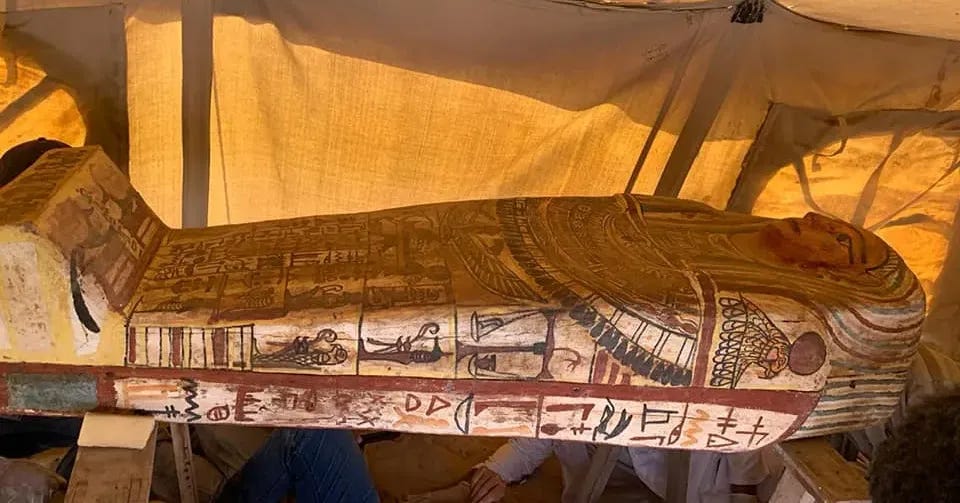
In the autumn of 2020, Egyptian archaeologists working at Saqqara pulled open a burial shaft that had not been touched since antiquity and found more than a hundred wooden coffins stacked inside, many still holding their original mummies. The coffins date to roughly 500 BCE, a period called the Late Period of ancient Egyptian history, and represent one of the largest intact caches of sealed burials found in the region in decades. Officials described paint on some of the coffins as bright enough to look almost freshly applied, protected for two and a half thousand years by the dry desert shaft that sealed them in.
Egypt’s Supreme Council of Antiquities, led at the time by Secretary-General Mostafa Waziri, announced the first cache of 59 coffins in early October 2020, then kept adding to the count as excavation continued, eventually confirming more than 100 coffins from the same shaft complex by January 2021. Officials opened one coffin live in front of television cameras during the initial announcement, revealing a well-preserved mummy wrapped in linen, a moment intended partly for the cameras but also useful for demonstrating just how undisturbed the burials really were.
Saqqara had already produced tombs, pyramids, and animal necropolises for more than a century of excavation before this find, which raises an obvious question: how does a site this thoroughly studied still hold burial shafts nobody had opened. The answer lies in scale. Saqqara covers roughly seven square kilometers of desert plateau west of modern Cairo and served as the primary burial ground for the capital city of Memphis for close to three thousand years, across dozens of dynasties, which means most of it has never been systematically excavated at all.
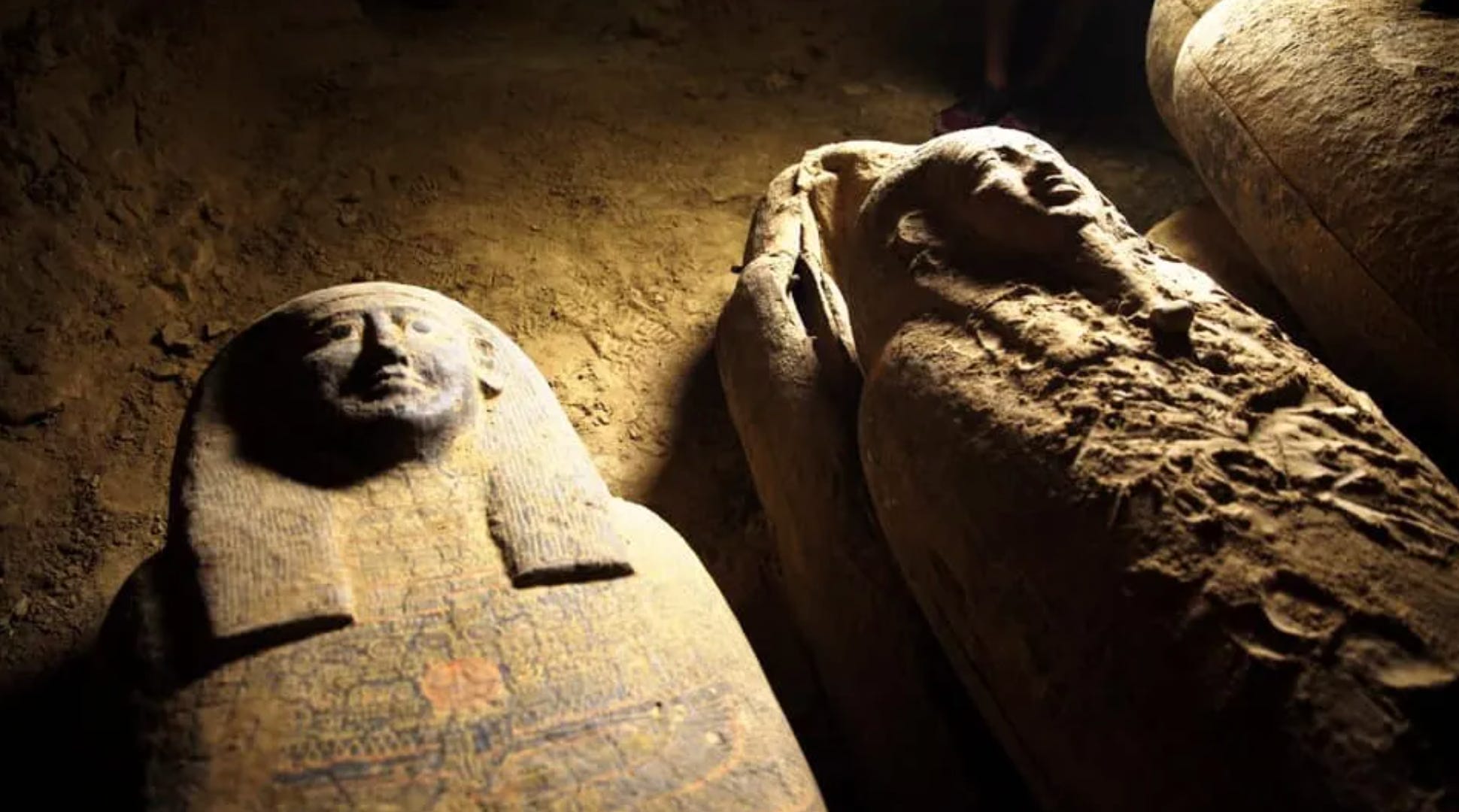
These coffins tell a story less about individual people and more about a changing industry. By the time these burials were made, Egypt’s political power had faded considerably. The country had been ruled by Nubian and then Persian dynasties within living memory, and centralized pharaonic authority no longer controlled society the way it had a thousand years earlier. What thrived instead was a private mummification economy, workshops and priests selling burial preparation and coffin decoration as a commercial service to a much wider swath of Egyptian society than royalty alone.
Death Becomes a Growth Industry
Middle-ranking officials, priests, scribes, and merchants who could never have afforded elaborate burial in earlier centuries were now purchasing mass-produced coffins decorated with standardized religious scenes meant to guarantee safe passage through the underworld. Coffin makers worked from templates, filling in a name here and a title there, which explains why so many Late Period coffins share nearly identical decoration despite belonging to different individuals. Mummification itself had also become more commercialized, offered at several price points depending on how much a family could spend, according to descriptions later recorded by the Greek historian Herodotus after his own visit to Egypt.
Saqqara’s location made it a natural center for this expanding industry. The site sat beside the sacred animal necropolises dedicated to the Apis bulls and other creatures linked to the god Ptah, drawing pilgrims, priests, and religious commerce to the area independent of royal burial activity. A booming afterlife economy building up around a sacred landscape originally meant for kings and bulls left behind exactly the kind of densely packed, poorly documented shafts that keep surfacing new discoveries even after more than 150 years of professional excavation.
What the Coffins Still Have to Say
Researchers used CT scanning on some of the mummies to examine them without unwrapping or damaging the linen, identifying details like age, sex, and even evidence of certain diseases without disturbing burials that had remained sealed for millennia. Inscriptions painted on the coffins recorded names, titles, and prayers meant to help the deceased navigate the underworld, giving Egyptologists thousands of small biographical fragments about people who left no other written record of their lives.
Alongside the coffins, excavators recovered wooden statues of protective deities, a scattering of ushabti funerary figurines meant to perform labor for the deceased in the afterlife, and a well-preserved gilded statue of the child god Nefertem discovered nearby in a related shaft, which the Antiquities Ministry singled out as one of the find’s standout pieces, and later put on display at the newly opened Grand Egyptian Museum outside Cairo so the wider public could see it too.
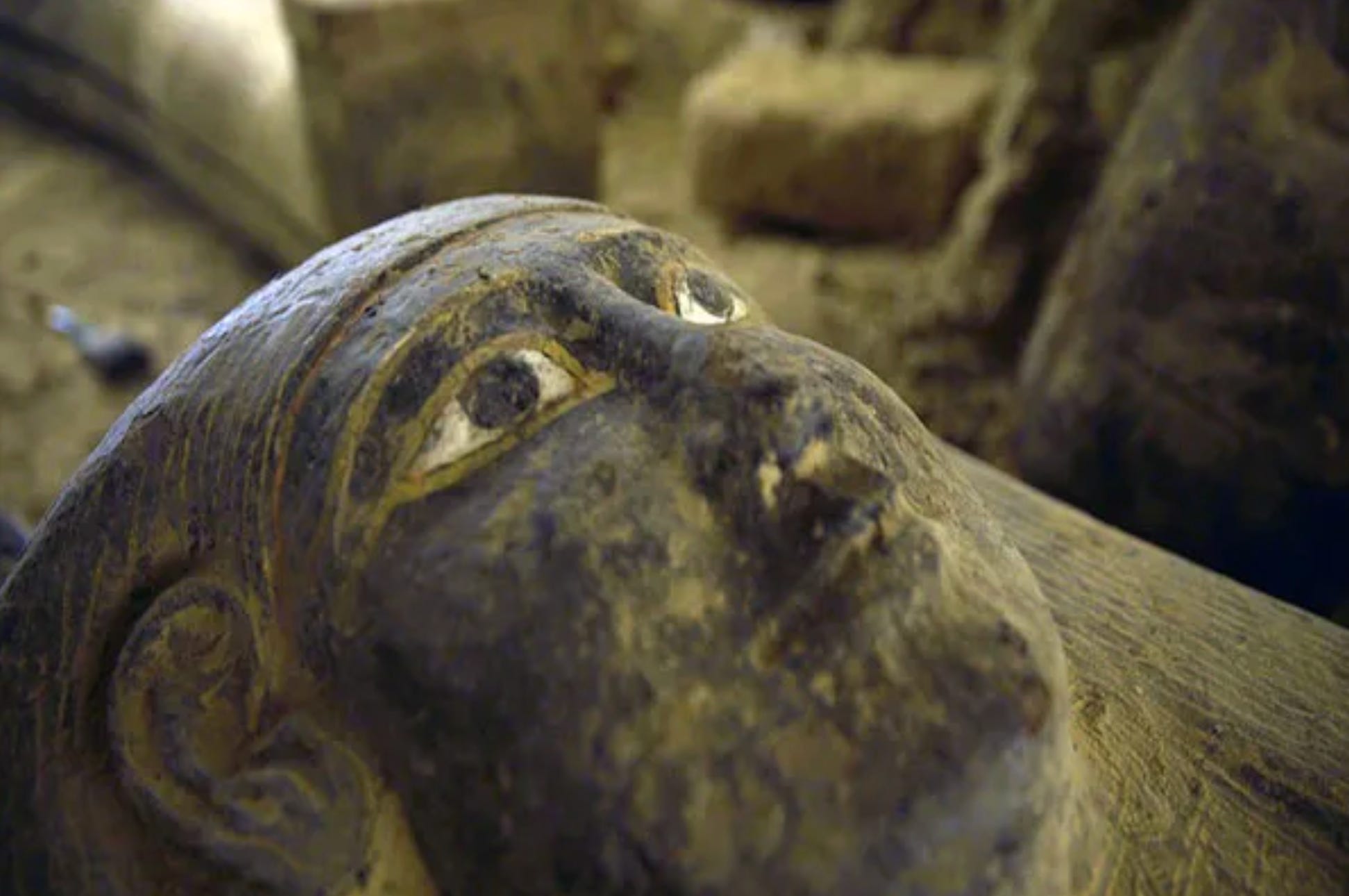
A coffin bought off a template, decorated by a workshop artist who never met the person inside, turns out to preserve more honest information about ordinary Late Period life than most royal monuments ever intended to share. Kings built temples to be remembered. Everyone else, it turns out, just wanted to be sent into the afterlife properly, and was apparently willing to pay whatever a workshop charged to make that happen.
If future archaeologists judged our era by what we chose to spend money protecting after death, what do you think they’d conclude about how we lived?

Well, I guess the old saying needs an update: death, taxes, and yet another batch of perfectly preserved mummies popping out of the sands of Egypt—because apparently Saqqara is the gift that just keeps on giving, even after 2,500 years.