


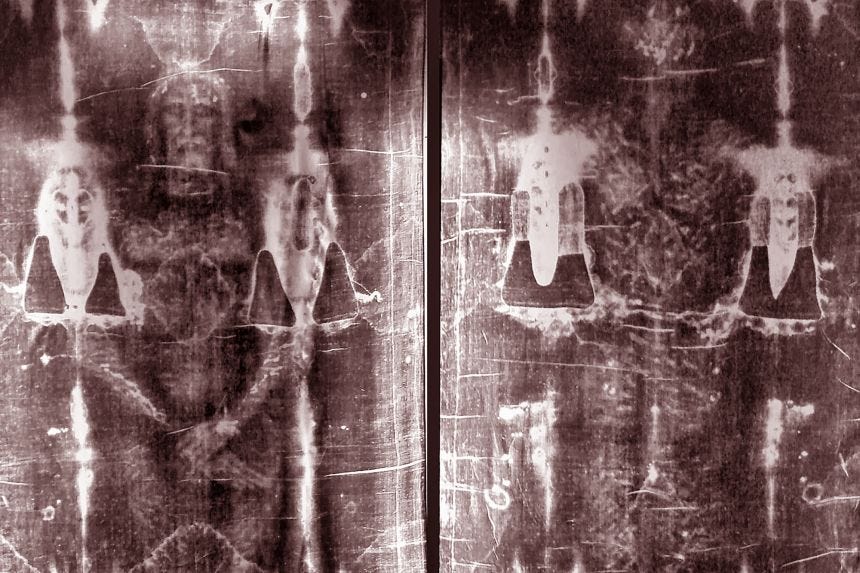
A 14-foot linen cloth bearing the faint image of a bearded man showing wounds consistent with crucifixion has been venerated for centuries as the burial cloth of Jesus, known today as the Shroud of Turin. It first appears in verified historical record in the 1350s, when a French knight named Geoffroi de Charny displayed it in a church in Lirey, France. Local bishop Pierre d’Arcis wrote to the pope in 1389 claiming an earlier investigation had found the artist who painted it, though that artist’s name was never recorded and no such confession survives today.
In 1988, three separate laboratories in Oxford, Zurich, and Arizona carried out radiocarbon dating on small samples cut from the shroud and dated the cloth to between 1260 and 1390, placing its origin squarely within the medieval period rather than the first century. The results were published in the journal Nature and are treated by most textile historians and scientists as strong evidence the shroud is a medieval creation rather than an ancient relic.
Believers in the shroud’s authenticity raise several objections to that conclusion. Some argue the tested sample came from a medieval repair patch woven into the fabric after a 1532 fire damaged the original cloth, rather than from the shroud’s original material. Others point to pollen grains and limestone particles found on the cloth that are more common in the Jerusalem region than in medieval Europe, and to microscopic image details, like apparent coin impressions over the eyes, that they argue a medieval forger could not have known to include.
Scientists studying the image formation itself remain divided over how it was created. Some researchers have reproduced similar images using techniques available to medieval artists, including pressing cloth against a heated or pigmented relief. Others maintain that no medieval technology could account for the image’s unusual properties, particularly the way it appears to encode three dimensional depth information, something photographic negatives can capture but flat paintings generally cannot replicate this precisely.
Catholic officials have never formally declared the shroud authentic, treating it instead as an object of devotion rather than a certified relic, which leaves the question open even within the institution most invested in the answer. Access for new scientific testing remains tightly restricted, so any resolution likely depends on techniques not yet available or a Vatican decision to allow more extensive sampling than it has permitted so far.
Do you think the 1988 radiocarbon dating settled the question, or is there still a real case for the shroud’s authenticity?
I like the story that this is an image of Templar Jaques de Molay made during his torture by the French king. Part of the torture involved crucifixion (but not to death), and de Molay was then placed on the linen cloth and also covered with it, creating the image.
I doubt that an objective conclusion can be made on this one.