


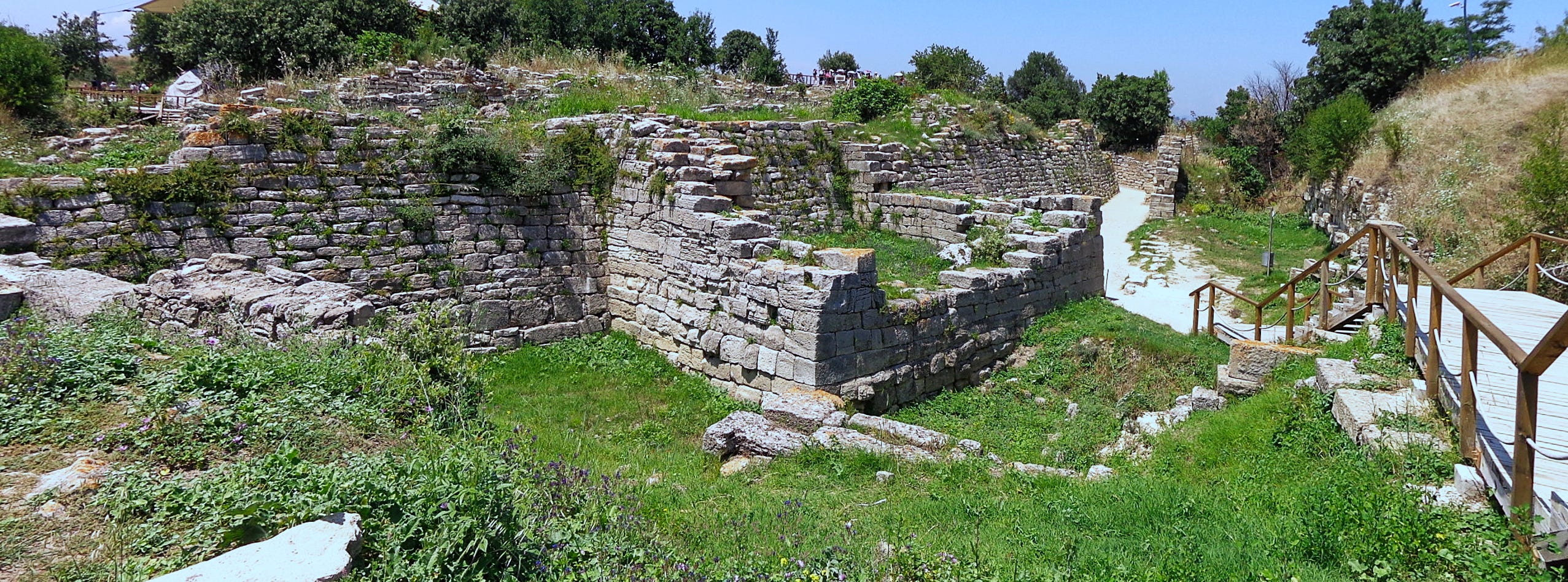
For more than 150 years, archaeologists have dug into a hill in northwestern Turkey looking for the historical reality behind one of the world’s most famous stories.
The mound is called Hisarlik. It stands near the Dardanelles, the narrow waterway linking the Aegean Sea to the Sea of Marmara and the Black Sea. Since antiquity, Greeks and Romans identified this landscape as the region of Troy. In the nineteenth century, the German businessman and amateur excavator Heinrich Schliemann made that identification famous around the world.
Schliemann arrived convinced that Homer’s Troy could be found in the ground. He began major excavations at Hisarlik in 1871, working with a level of speed and force that later archaeologists found appalling. His workers cut a huge trench through the mound in search of a dramatic Bronze Age city and its treasures. In doing so, they destroyed or badly damaged parts of several occupation layers.
His most famous discovery, the so-called “Priam’s Treasure,” was not the treasure of Homeric Troy. It came from a much earlier layer, now known as Troy II, dating to roughly 2500 BCE. That city was already more than a thousand years old by the time a plausible setting for a Trojan War would have existed.
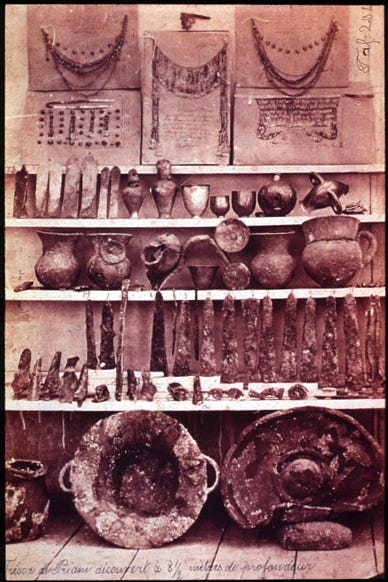
Schliemann was wrong about the layer. He was not wrong that Hisarlik was an extraordinary site.
Archaeologists now recognize a long sequence of settlements there, conventionally divided into nine major phases and many subphases. The mound was occupied from the Early Bronze Age, around 3000 BCE, through Greek, Roman, and Byzantine periods. There was not one Troy. There were many cities built, damaged, abandoned, and rebuilt on the same strategic hill over more than three millennia.
The debate centers on the Late Bronze Age settlements called Troy VI and Troy VIIa.
The City Homer May Have Remembered
Troy VI flourished between roughly 1700 and 1300 BCE. It had substantial fortification walls built from carefully fitted stone, imposing towers, and a citadel that would have looked formidable to anyone approaching from the plain below. Mycenaean Greek pottery found at the site shows that the city had contact with the Greek-speaking world across the Aegean.
Around 1300 BCE, Troy VI suffered severe damage. Many archaeologists have concluded that an earthquake was the likeliest cause. The walls show signs of collapse, but the destruction does not provide clear evidence of a military assault.
Troy VIIa followed directly after it. The city was rebuilt, but its character changed. Houses inside the citadel were divided and altered, while large storage jars were placed in rooms and courtyards. Some archaeologists have interpreted these changes as evidence of a population under pressure, perhaps preparing for shortages or danger. Others caution that crowded housing and storage jars do not prove a siege.
Troy VIIa ended in destruction, probably in the twelfth century BCE. Burned debris, damaged structures, and a small number of human remains show that the end was violent or at least catastrophic. The date places it close to the period traditionally associated with the Trojan War by ancient Greek chronographers.
That is why Troy VIIa is often presented as the leading archaeological candidate for a historical Troy. But “leading candidate” is not the same as proof.
The evidence does not tell us who attacked the city, whether it was attacked from outside, how long any conflict lasted, or whether the destruction was part of a local war, a raid, a revolt, or the wider upheaval that affected the eastern Mediterranean at the end of the Bronze Age.
There is no archaeological evidence for Achilles, Agamemnon, Helen, Priam, or the Trojan Horse. There is no evidence for a ten-year Greek siege.
And there is an important literary point often missed in popular retellings: the Iliad itself does not describe the fall or burning of Troy. It takes place during a short period late in the war and ends with the funeral of Hector. The Horse and the city’s destruction belong to other ancient traditions, especially the later Epic Cycle and Virgil’s Aeneid.
A burn layer at Troy is historically significant. It is not a scene from Homer preserved in the soil.