

The Viking Who Traveled Further East Than Any Explorer Before Columbus

When people think about Viking exploration, they think west. Leif Erikson reaching North America. The settlement at L’Anse aux Meadows. The longships pushing across the North Atlantic into territory no European had reached before. That story is accurate, and it is remarkable. But it is only half the picture, and arguably not the more impressive half.
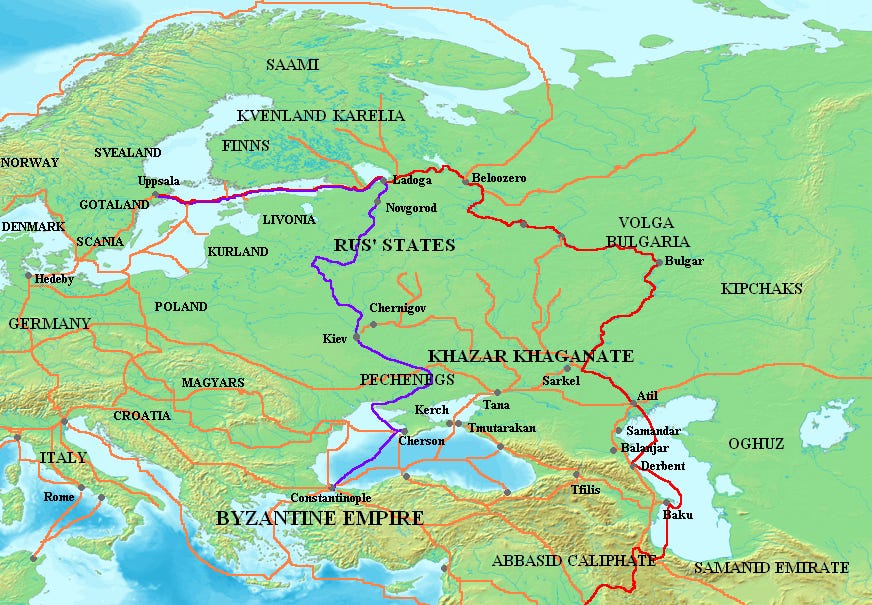
While some Norse groups were sailing west into the Atlantic, others were moving east, deep into the river systems of what is now Russia, Ukraine, and beyond. They established trading cities, served as elite mercenary forces for foreign rulers, and pushed along trade routes that eventually connected the Norse world to Byzantium, the Abbasid Caliphate, and the markets of Central Asia. The furthest reaches of that eastern expansion have been consistently underappreciated in popular accounts of the Viking Age, partly because the evidence was scattered across a dozen countries and partly because the story required integrating archaeological, numismatic, and genetic evidence that was only recently available.
Recent work has sharpened the picture considerably. Genetic analysis of burial populations, combined with new analysis of coin hoards and material culture, has extended the documented reach of Norse activity into Central Asia well beyond what was previously confirmed. One burial site in particular has attracted significant attention, and the story it tells about how far one person traveled, and what they carried with them, is difficult to categorize in the terms the popular narrative of the Vikings usually provides.
The Varangians and the Eastern Routes
The Norse groups who moved east are known in the historical sources as Varangians, a term used by Byzantine and Slavic sources to describe the Scandinavian traders and warriors who operated through the river networks of eastern Europe. Their primary routes ran from the Baltic south along the Volga and Dnieper rivers to the Black and Caspian Seas, connecting Nordic Scandinavia to Constantinople and to the trading cities of the Caspian littoral.
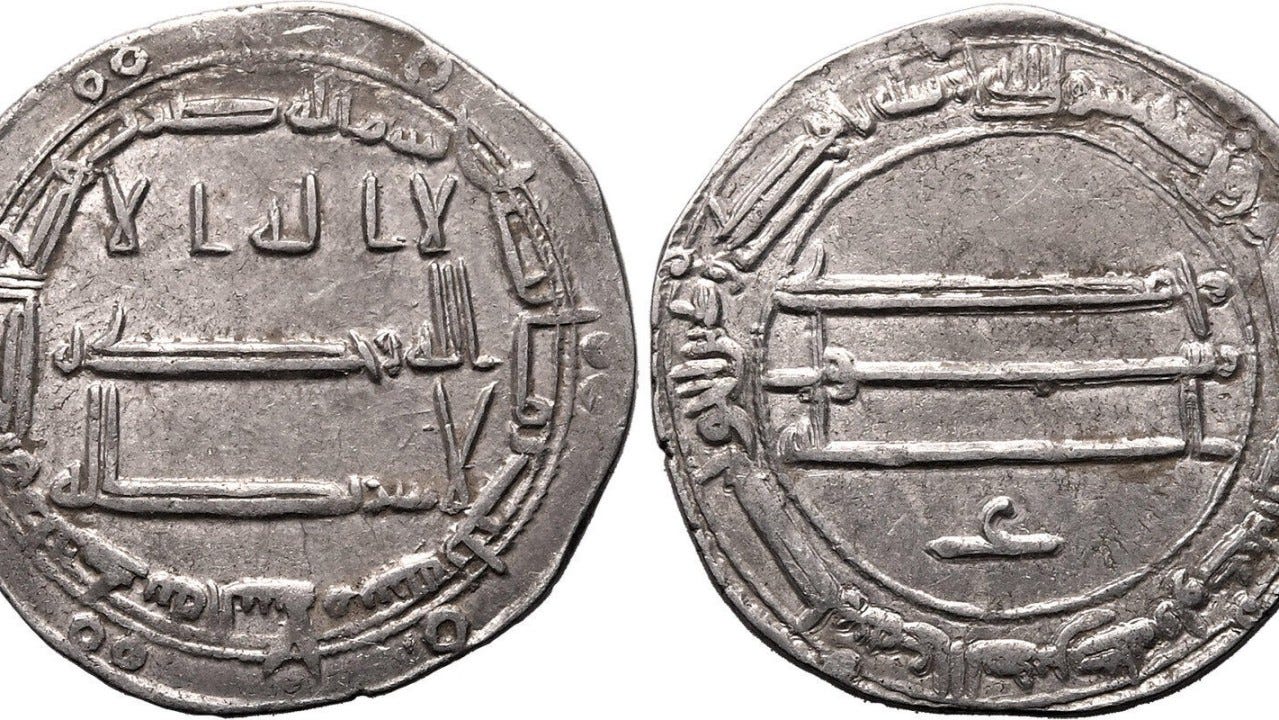
The volume of silver that moved along those routes is staggering. Hundreds of thousands of Abbasid dirhams, silver coins minted in Baghdad and across the Islamic world, have been found in Scandinavian hoards. The largest single hoard, found on the Swedish island of Gotland, contained over 14,000 Arabic coins. Gotland alone has produced more Arabic silver than anywhere else in northern Europe, a remarkable concentration that reflects the island’s role as a major node in the Varangian trade network. This silver did not travel from Baghdad to Gotland by accident. It moved through a network of traders who knew the routes, knew the markets, and were willing to travel extraordinary distances to access them.
The Varangians were not simply traders. At the Caspian end of the route, Norse groups raided as well as traded, and the distinction between the two activities was often situational. Arab sources describe Norse raiders attacking settlements along the Caspian coast in the early tenth century, operations that required knowledge of the region, logistical capability, and the kind of relationship with local intermediaries that could only come from sustained engagement with the area. These were not one-off raids by people who had stumbled onto an unknown coast. They were operations conducted by groups with deep familiarity with the territory.
The Genetic and Numismatic Evidence
For most of the twentieth century, the eastern extent of confirmed Norse activity was roughly the Caspian Sea region and the northern reaches of Central Asia. The Arabic coins in Scandinavian hoards implied contacts further east, since the coin minting locations extended deep into the Islamic world, but physical evidence of Norse presence beyond the Volga-Caspian corridor was limited.
Ancient DNA analysis has begun to change that. Studies of burial populations along the major river routes have identified individuals of Scandinavian genetic ancestry in locations that extend the known range of Norse movement. More significantly, analysis of grave goods in several Central Asian burial contexts has identified objects of clearly Norse manufacture, not trade goods that could have passed through multiple intermediary hands, but personal items, weapons, and ornaments of a type specific to Scandinavian production traditions.
One burial site, located in the region south of the Aral Sea, has produced a combination of evidence that is difficult to explain without direct Norse presence. The genetic profile of the individual is consistent with Scandinavian origin. The grave goods include items of Norse manufacture alongside objects from multiple cultures encountered along the eastern routes, Byzantine, Khazar, and Central Asian. The coin assemblage includes specimens minted in locations spanning from northern Europe to Samarkand. This was not a person who stayed in one place. The material record of the burial reads like a map of a life spent moving through the connected world of the tenth-century Eurasian trade network.

What This Person’s Life Would Have Looked Like
Reconstructing the biography of a person from burial goods is inherently speculative, but the range of material in this burial tells a coherent story. Someone who started life in Scandinavia, moved east through the Varangian routes, spent time in the Byzantine sphere where the distinctive personal ornaments were acquired, pushed further along the Caspian route into the trading world of the Khazar khanate, and eventually reached the Central Asian markets where the eastern coins were minted.
The journey from Scandinavia to the region south of the Aral Sea, following the river and overland routes available in the tenth century, would have covered something in the range of 5,000 to 6,000 kilometers. It would have required knowledge of multiple languages, or at minimum multiple trading pidgins. It would have required navigating different political systems, different currencies, and different cultural protocols for conducting business. The people who made these journeys were not simple raiders or itinerant merchants. They were sophisticated operators in a genuinely international commercial environment.
The Norse world is often presented as peripheral to the main currents of medieval history, a northern fringe producing spectacular ships and occasional raiders. The eastern evidence corrects that picture. The Varangian network connected the Baltic to the Islamic world’s most prosperous markets. The silver that flowed back through it funded the development of Scandinavian state formation. The knowledge acquired along those routes, of geography, of politics, of the cultures encountered, fed back into a society that was simultaneously raiding monasteries in Ireland and conducting sophisticated trade diplomacy with the Abbasid Caliphate.
The Viking buried somewhere south of the Aral Sea, with Norse ornaments and Samarkand coins and the genetic signature of a Scandinavian origin, traveled further from home than almost anyone of their era whose journey we can document. The western expansion into the Atlantic gets the attention. The eastern expansion, quieter in the historical record, was arguably more sustained, more commercially significant, and in some respects more impressive in what it required of the people who undertook it.
What does it mean that the same culture produced both Leif Erikson and the traders who reached Central Asia? And what other networks of movement and connection from the pre-modern world are we still underestimating because the evidence is scattered across too many countries for any single national tradition to have assembled it?
References
Price, Neil. The Children of Ash and Elm: A History of the Vikings. Basic Books, 2020.
Montgomery, James E. ‘Ibn Fadlan and the Rusiyyah.’ Journal of Arabic and Islamic Studies 3, 2000, pp. 1-25.
Jansson, Ingmar. ‘Communications Between Scandinavia and Eastern Europe in the Viking Age.’ In Untersuchungen zu Handel und Verkehr der vor- und fruhgeschichtlichen Zeit, 1987.
Sindbak, Soren M. ‘Coins, Bodies, Game Pieces and Knives: Defining Viking Age Connectivity.’ European Journal of Archaeology 18(4), 2015.
Hedenstierna-Jonson, Charlotte, et al. ‘A Female Viking Warrior Confirmed by Genomics.’ American Journal of Physical Anthropology 164(4), 2017, pp. 853-860.
Noonan, Thomas S. ‘The Vikings in the East: Coins and Commerce.’ Developments Around the Baltic and the North Sea in the Viking Age, 1994.